Cómo elegir un canal realista
Categories

When a project has already validated a problem, defined a value proposition, and run Experiments that provide evidence of people’s interest in the solution it proposes, it starts thinking about to get their first customers. And then, the question arises:
What channel should I use?
The easy and quick answer is usually the same: social media, SEO, advertising, emails. And most of the time, the answer is mistaken. A channel is the path to reach the right audience, also providing the framework in which the proposal can be understood. So the question you should ask yourself is…
How can I start a conversation with my customers?
Throughout the program, you have worked with experiments for to validate your hypotheses. With the channels you have to do exactly the same: you must identify who you are looking for, where to find it, what you will and what you will show behavior you want to provoke. Then, you will decide which channel best fits that goal.
You will choose it because it is the best available Hypothesis to achieve a specific action. Once chosen, you will run an Experiment, measure results, and decide whether to keep going, modify it, or discard it.
A realistic channel is not the most innovative or the most popular. It is not chosen due to personal preferences or because it is “trendy”, but because it is the ideal medium to provoke a specific action in a given audience.
One at a time
The channel is not only for acquiring customers; it is necessary to continue validating and move your project forward, since your priority at this stage is to reduce uncertainty.
That’s why, at the beginning, it is almost never advisable to use the largest or most automated channel, but the one that allows you to learn faster. A conversation with a potential customer can provide more information than hundreds of anonymous visits to a website. An in-person demonstration can help you uncover objections that would never appear in an advertising campaign. A recommendation can teach you why one person trusts your proposal while another ignores it.
At this point, you will likely have the temptation to open several channels at once: a profile on each social network, a newsletter, ad campaigns, a blog, collaborations, events… The more presence the project has, the more learning and opportunities will arise. But what usually happens is is exactly the opposite: resources become scattered, no channel receives enough attention, and it becomes impossible to know what is really working.
It is better to focus effort on one channel, run an Experiment for a reasonable period, and make decisions based on evidence. Once you find the one that works consistently, then it makes sense to incorporate the next one.
One channel for each need
If someone has just discovered they have a problem, they will probably look for content that helps them understand it. If they already know the problem exists and are comparing solutions, they may benefit from a demo, a conversation, or the testimonial of another customer. If they have already used your product and understood and obtained value from it, the next step could be recommending it to others. Thus, you will need different channels in each of these cases, since the situation is different.
However, one of the most common mistakes is to ask a only channel that does all the work:
To give visibility to the project
To generate trust.
To get sign-upss
To close sales.
To build customer loyalty customers.
In practice, this does not work. Each channel is usually effective for a specific part of the customer journey, and understanding this prevents one of the most common problems in the early stages of entrepreneurship: to measure results incorrectly. If you want to close immediate sales but use a medium designed to generate awareness, you will not achieve your goals and will conclude that this approach is not suitable for your project. However, the reality is that you are asking for something it was not designed to do.
The tool that will help you choose a channel
The formula is simple: situation + audience + action = channel. To solve it, you just need to answer three questions:
¿En qué situación está el potencial usuario?
¿A qué público quiero dirigirme?
What action do I need them to take?
With these answers, the channel will (almost) reveal itself. And if you still have doubts, always go back to the same sequence: first, the situation; then, the platform. Take a look at these examples:
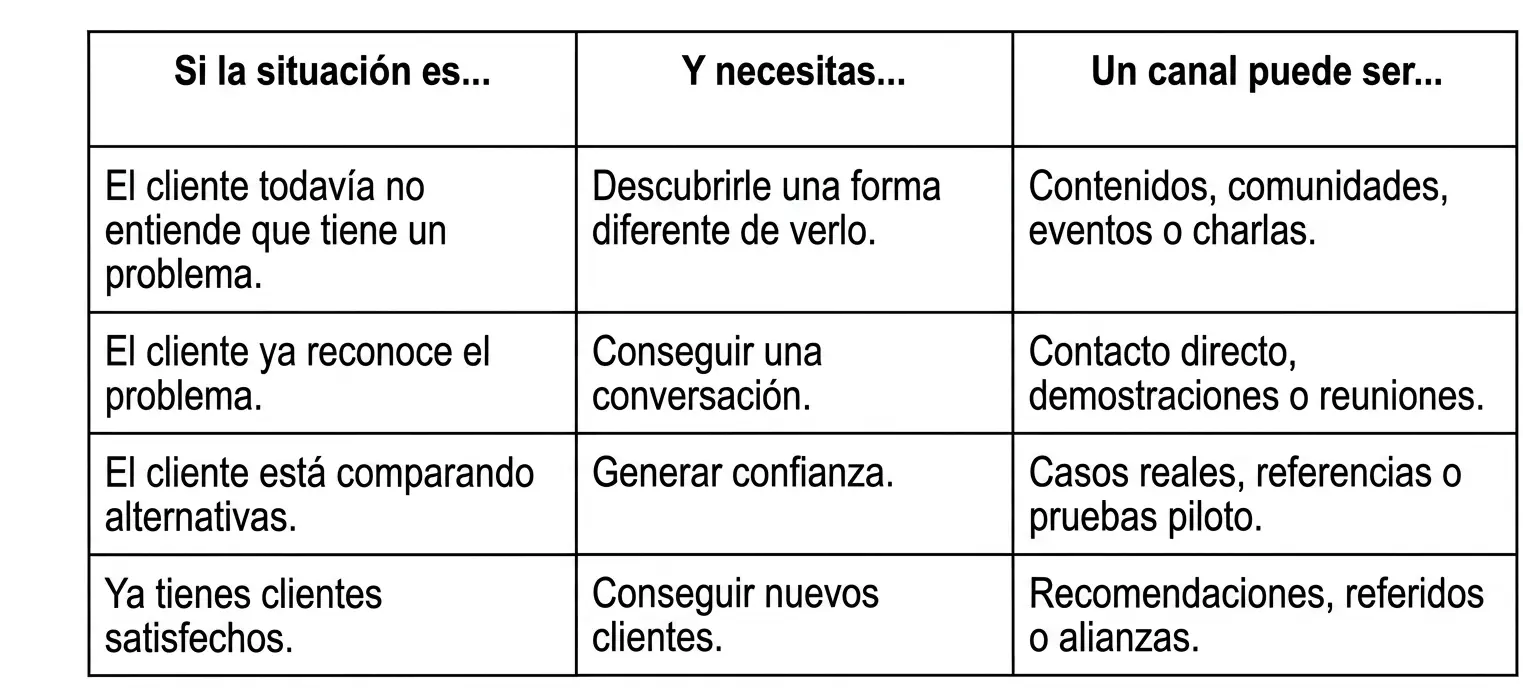
Remember, this is not a universal recipe, but a starting point. From here, the right combination will depend on your customer, your value proposition, and the stage your project is in.